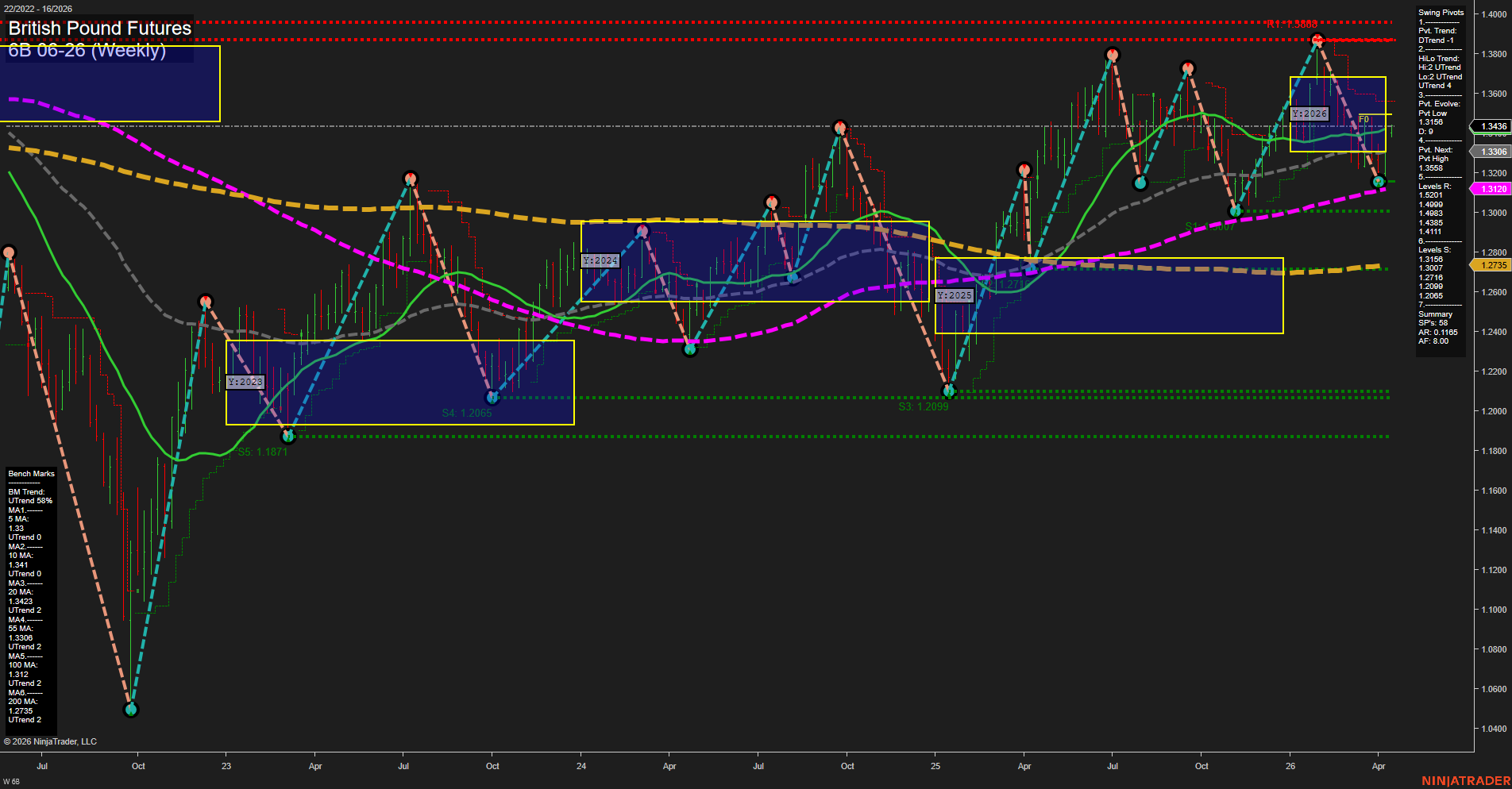
The British Pound Futures (6B) weekly chart shows a market in transition. Price action is currently above the short- and intermediate-term Fib grid centers, with medium-sized bars and average momentum, suggesting a steady but not aggressive move. The short-term WSFG and intermediate-term MSFG both indicate upward trends, supported by recent long trade signals and all benchmark moving averages trending higher. However, the yearly grid (YSFG) remains in a mild downtrend, with price still below the annual NTZ center, reflecting longer-term hesitation or consolidation after prior rallies. Swing pivots reveal a short-term downtrend (DTrend) but an intermediate-term uptrend (UTrend), with the most recent pivot low at 1.3160 and resistance levels clustered just above the current price. This suggests the market is testing overhead resistance after a bounce from support, with the next significant pivot high at 1.3516. The cluster of resistance levels between 1.3443 and 1.3588 could act as a ceiling unless momentum accelerates. All major moving averages (5, 10, 20, 55, 100, 200 week) are in uptrends, reinforcing the intermediate-term bullish bias. The recent sequence of long signals across short, intermediate, and long-term systems highlights renewed buying interest, possibly in response to a pullback or retracement within a broader uptrend. Overall, the chart reflects a market in a corrective phase within a larger bullish structure, with short-term consolidation or choppiness likely as price navigates resistance. The intermediate-term outlook remains constructive, while the long-term trend is neutral, awaiting a decisive breakout above yearly resistance or a deeper retracement. This environment favors swing traders who can adapt to both trend continuation and mean-reversion setups as the market tests key levels.