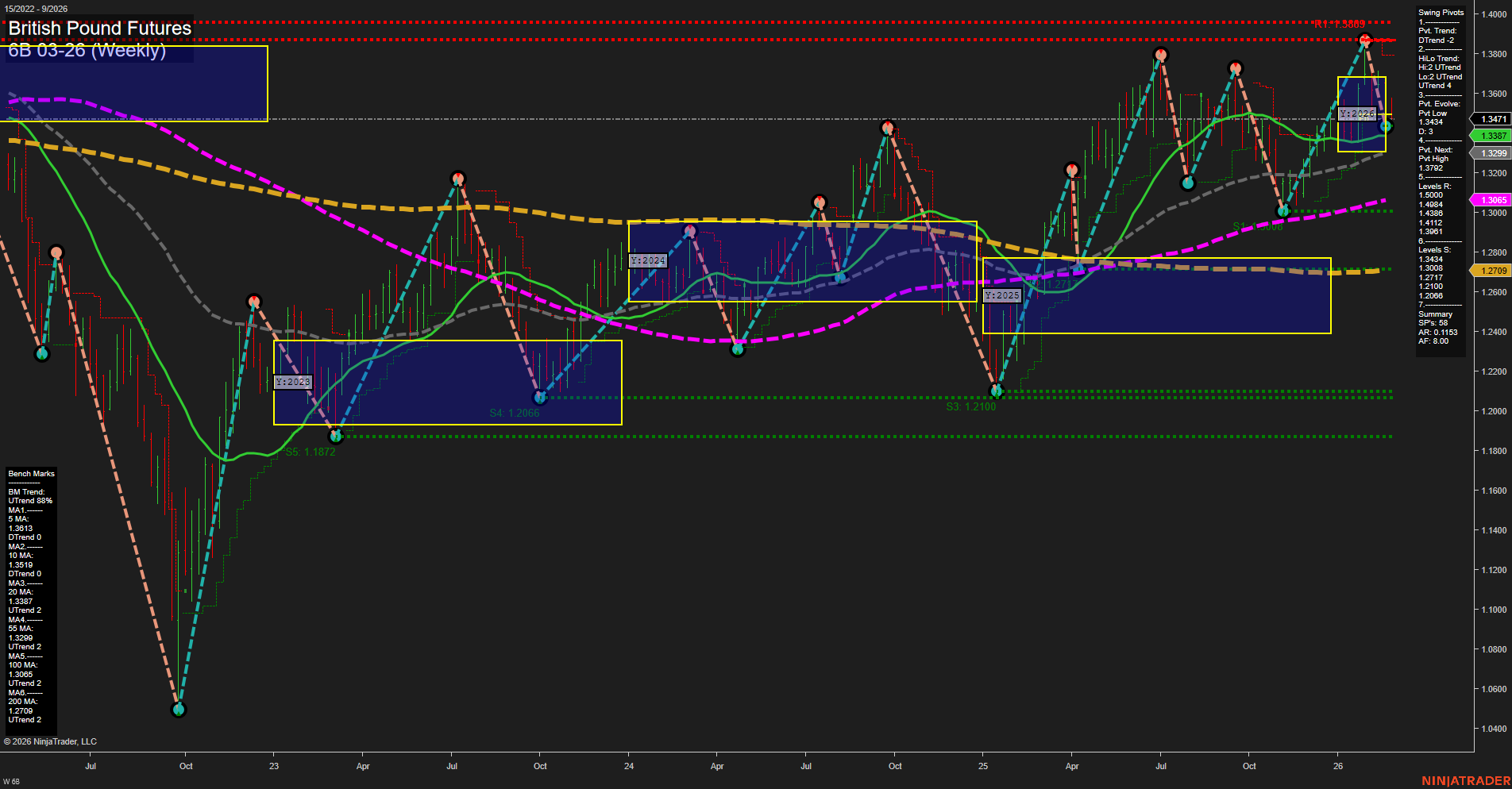
The British Pound Futures (6B) weekly chart shows a mixed technical landscape. Price action is currently at 1.3471 with medium-sized bars and average momentum, indicating neither extreme volatility nor stagnation. The short-term (WSFG) and intermediate-term (MSFG) Fibonacci grid trends are both down, with price trading below their respective NTZ (neutral trading zones), suggesting recent weakness and a short-term bearish bias. This is reinforced by the latest trade signals, both of which are short entries. Swing pivot analysis reveals a short-term downtrend (DTrend) but an intermediate-term uptrend (UTrend), highlighting a possible transition phase or a corrective pullback within a larger bullish structure. The most recent pivot is a high at 1.3471, with the next key support at 1.3329. Resistance levels are stacked above at 1.3471, 1.3609, and 1.3689, while support extends down to 1.3329 and further to 1.2207 and below. Benchmark moving averages across all timeframes (5, 10, 20, 55, 100, and 200 weeks) are in uptrends, indicating that the broader and long-term structure remains bullish despite the current pullback. This suggests that while the short-term is under pressure, the longer-term trend is still intact. Overall, the chart reflects a short-term bearish phase within a longer-term bullish trend. The market appears to be in a corrective or consolidation phase, with potential for further downside in the near term before the broader uptrend may reassert itself. Swing traders should note the interplay between short-term weakness and long-term strength, as well as the proximity to key support and resistance levels, which could define the next directional move.