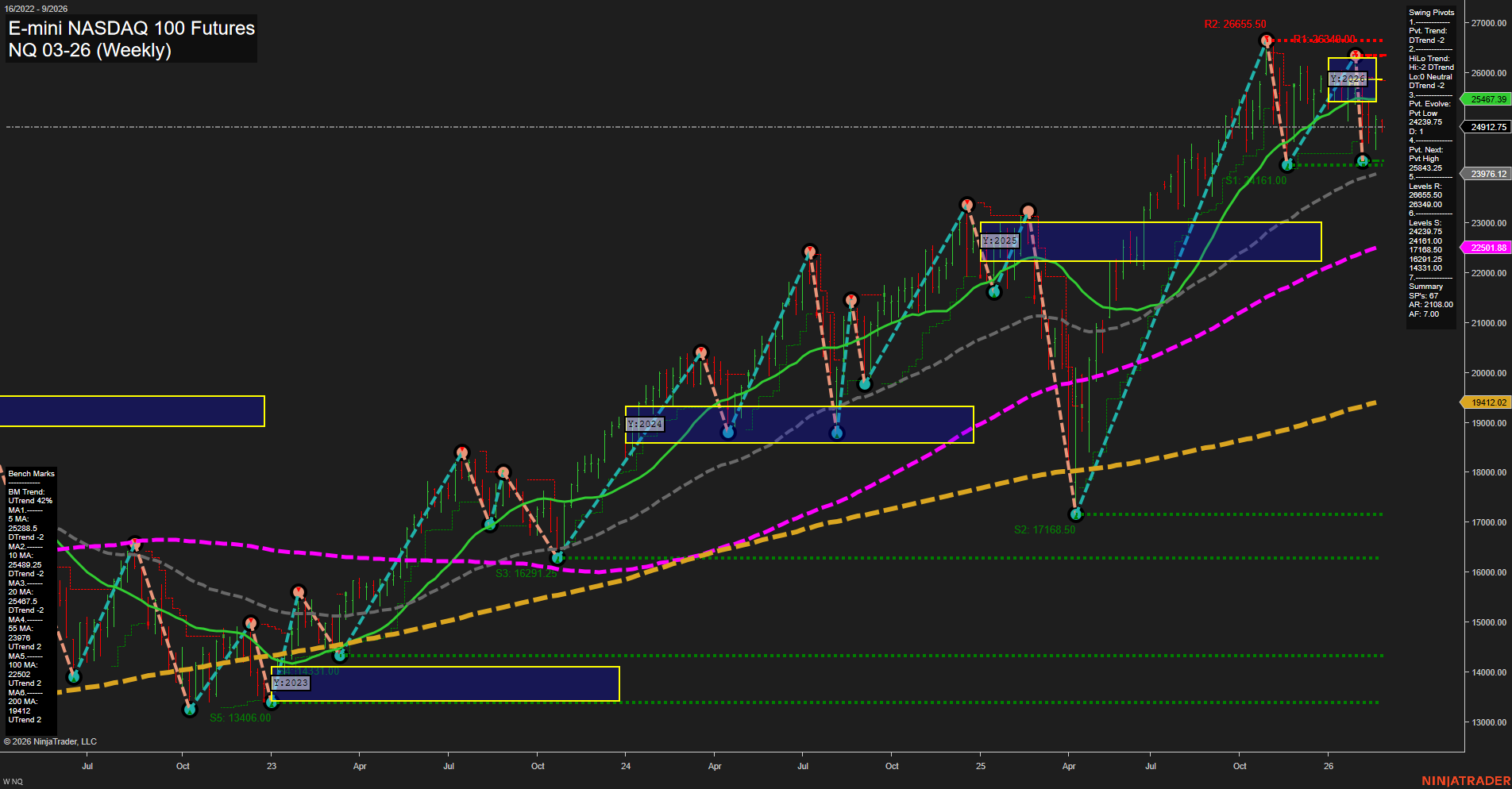
The NQ E-mini NASDAQ 100 Futures weekly chart is showing a notable shift in momentum, with price action currently below key Fibonacci grid levels across short, intermediate, and long-term timeframes. The most recent bars are medium in size, but momentum is slow, indicating a lack of strong conviction in either direction. Both the short-term and intermediate-term trends are down, as confirmed by the WSFG and MSFG readings, as well as the swing pivot and HiLo trends, which are both in a downtrend. Resistance is clustered near recent highs (26555.50, 26548.25), while support is found at 23976.12 and lower at 21601.00 and 17168.50, suggesting a wide range for potential price movement. Benchmark moving averages for the 5, 10, and 20-week periods are all trending down, reinforcing the bearish tone in the short and intermediate term. However, the longer-term 55, 100, and 200-week moving averages remain in uptrends, indicating that the broader bullish structure is still intact, though under pressure. Recent trade signals show mixed activity, with a short signal most recently triggered, aligning with the prevailing short-term bearish sentiment. Overall, the chart reflects a market in corrective mode after a strong prior uptrend, with sellers currently in control on the weekly timeframe. The environment is characterized by a pullback or retracement phase, with the potential for further downside if support levels do not hold. However, the underlying long-term trend remains neutral, as major moving averages have not yet rolled over. This setup often precedes periods of increased volatility and choppy price action as the market seeks direction.