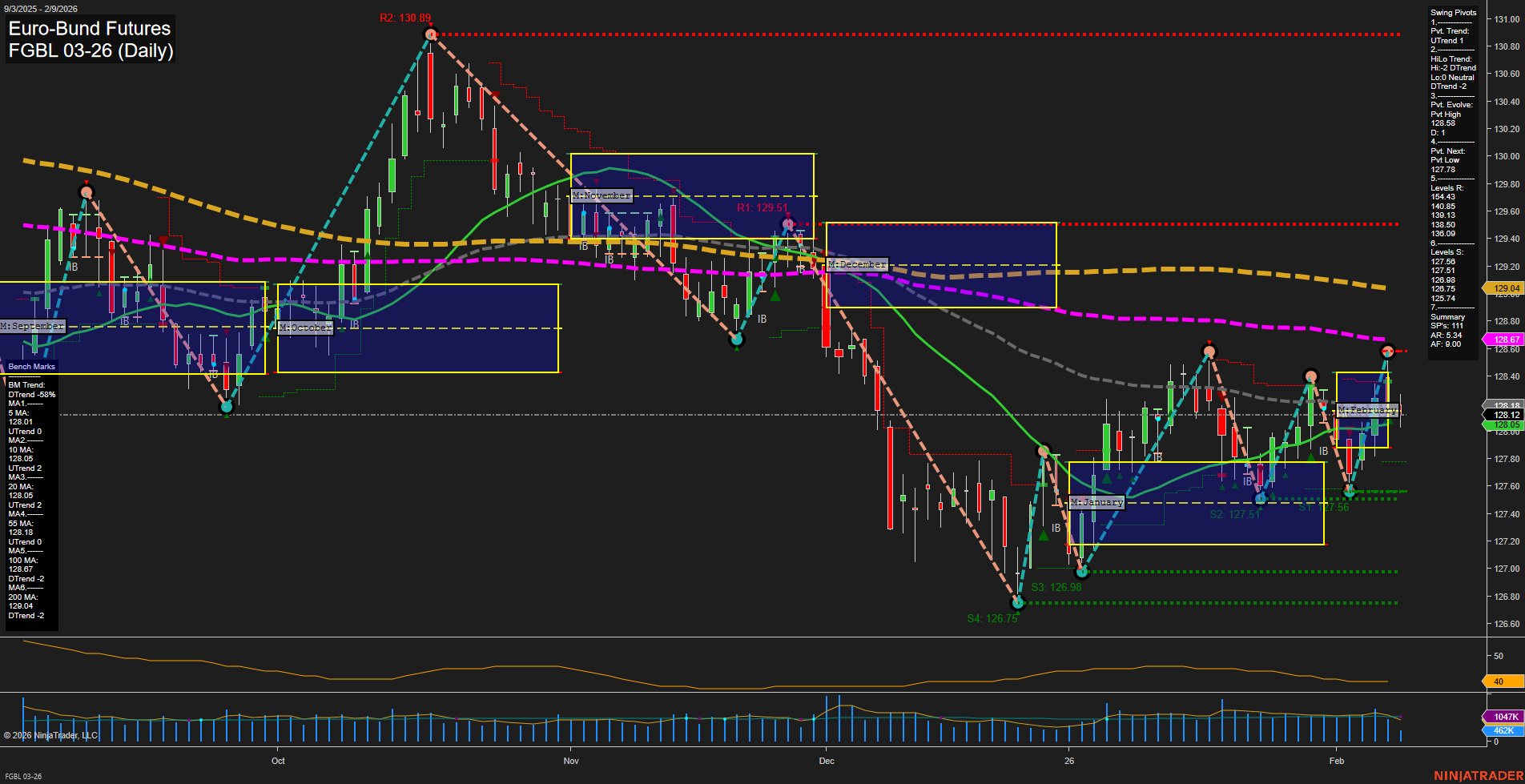
The FGBL Euro-Bund Futures daily chart shows a market in transition. Short-term price action is characterized by medium-sized bars and average momentum, with the last price at 128.05. The weekly session fib grid (WSFG) trend is down, with price below the NTZ, indicating short-term bearishness. However, the monthly session fib grid (MSFG) is neutral, and the yearly session fib grid (YSFG) remains up, suggesting that the longer-term structure is still bullish. Swing pivots reveal a short-term uptrend (UTrend) but an intermediate-term downtrend (DTrend), with the most recent pivot high at 128.67 and the next potential pivot low at 127.78. Resistance levels are clustered above at 128.67, 129.51, and 130.89, while support is layered below at 127.56, 127.51, 126.96, and 126.75. Benchmark moving averages show short-term uptrends (5, 10, and 20-day MAs), but intermediate and long-term averages (55, 100, and 200-day) are still in downtrends, reflecting a market that is attempting to recover but faces overhead resistance from longer-term sellers. ATR and volume metrics indicate moderate volatility and healthy participation. Recent trade signals highlight a shift, with short-term signals flipping to short on February 9th after a brief long signal on February 6th, reflecting the choppy and indecisive nature of the current environment. Overall, the market is consolidating after a prior sell-off, with short-term and intermediate-term trends neutralizing while the long-term trend remains bullish. Price is caught between resistance and support, and the market is likely to remain range-bound until a decisive breakout or breakdown occurs. Swing traders should note the mixed signals and the potential for both mean reversion and trend continuation setups as the market digests recent moves.