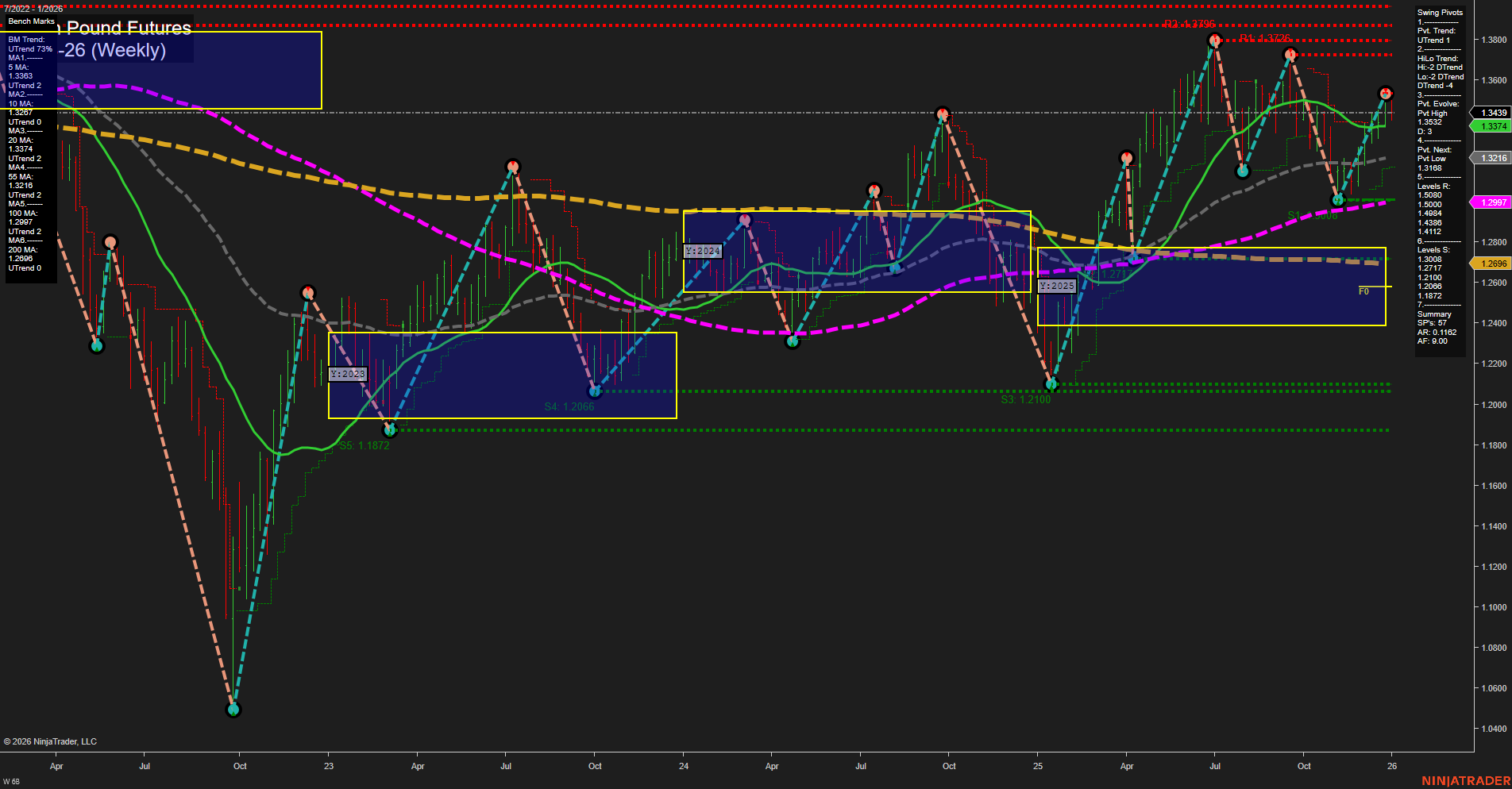
The British Pound Futures (6B) weekly chart shows a market in transition. Price action is currently at 1.3349 with medium-sized bars and average momentum, indicating neither strong acceleration nor significant weakness. Short-term and intermediate-term Fib grid trends (WSFG and MSFG) are both down, with price below their respective NTZ/F0% levels, suggesting recent weakness and a lack of short-term bullish conviction. However, the long-term YSFG trend remains up, with price above the yearly NTZ/F0% and a positive 45% reading, reflecting a broader bullish structure. Swing pivots highlight a short-term uptrend but an intermediate-term downtrend, with the most recent pivot high at 1.3349 and the next key support at 1.3216. Resistance levels are stacked above, with significant levels at 1.3542, 1.3726, and 1.3796, while support is found at 1.3216 and further below at 1.2665 and 1.2066. All benchmark moving averages from 5-week to 200-week are in uptrends, reinforcing the underlying long-term bullish bias despite recent short-term pullbacks. Recent trade signals have triggered short entries, aligning with the short-term and intermediate-term bearish signals, but these are counter to the prevailing long-term uptrend. Overall, the market is experiencing a short-term and intermediate-term pullback within a larger bullish trend. This environment is typical of a corrective phase or consolidation within a broader uptrend, with potential for volatility as the market tests support and resistance levels. Swing traders should note the mixed signals across timeframes, with short-term neutrality, intermediate-term bearishness, and long-term bullishness dominating the current landscape.