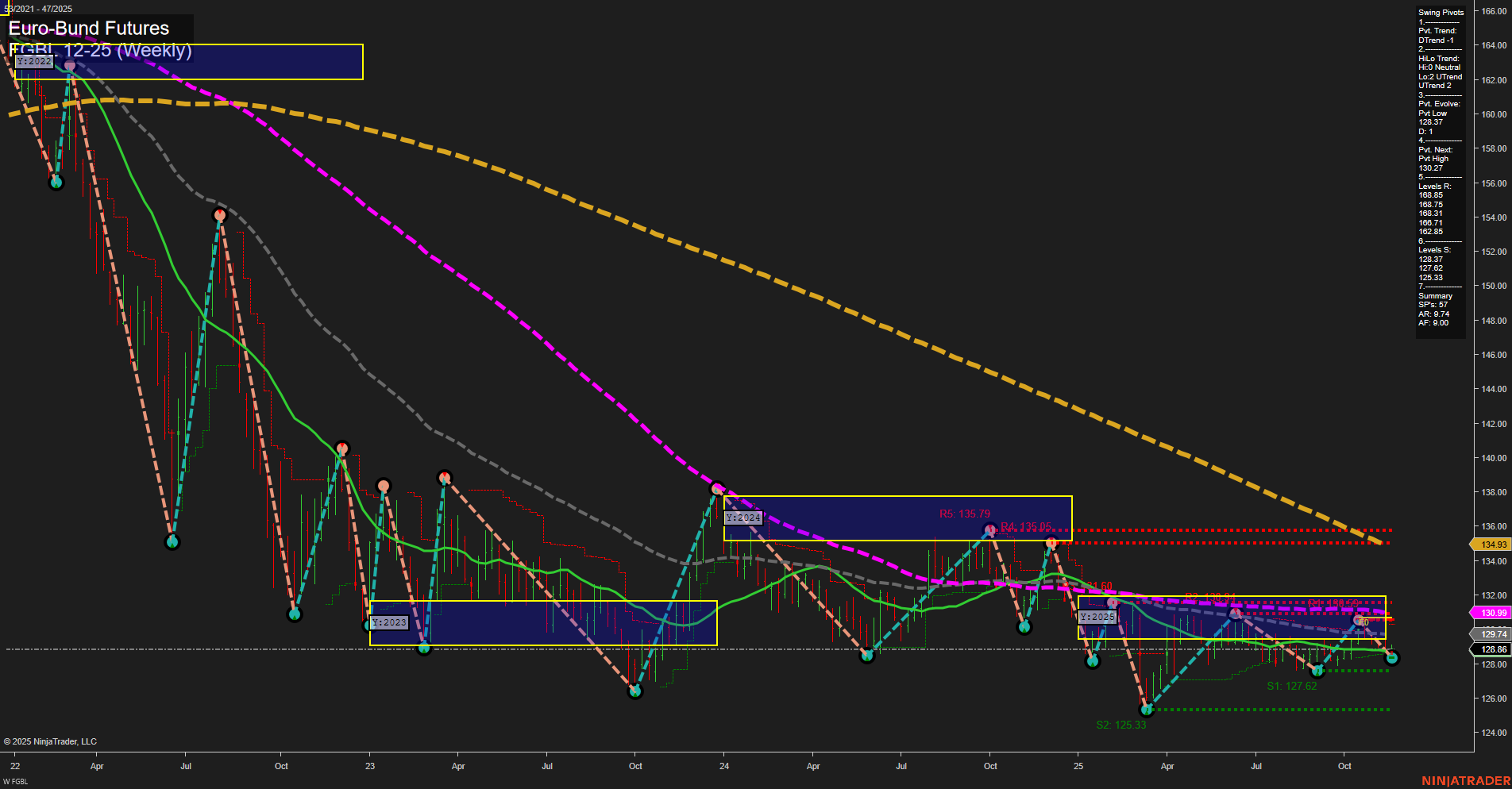
The Euro-Bund Futures weekly chart shows a market in transition. Short-term price action is neutral, with slow momentum and medium-sized bars, reflecting a lack of strong conviction. The Weekly Session Fib Grid (WSFG) and Monthly Session Fib Grid (MSFG) both indicate an upward trend, with price holding above their respective NTZ/F0% levels, suggesting some bullish undertone in the short and intermediate term. However, the Yearly Session Fib Grid (YSFG) remains in a downtrend, with price below the yearly NTZ/F0%, highlighting persistent long-term bearishness. Swing pivots show a short-term downtrend but an intermediate-term uptrend, with the most recent pivot low at 128.61 and the next resistance at 131.49. Key resistance levels cluster between 130.93 and 135.79, while support is found at 127.62 and 125.33. All major moving averages (5, 10, 20, 55, 100, 200 week) are trending down, reinforcing the dominant long-term bearish structure. Recent trade signals have triggered long entries, aligning with the intermediate-term bullish bias, but the overall environment remains mixed due to the strong overhead resistance and prevailing long-term downtrend. The market appears to be in a consolidation phase, with potential for range-bound trading as it tests key support and resistance levels. The interplay between short-term neutrality, intermediate-term bullishness, and long-term bearishness suggests a market at a crossroads, awaiting a decisive breakout or breakdown.