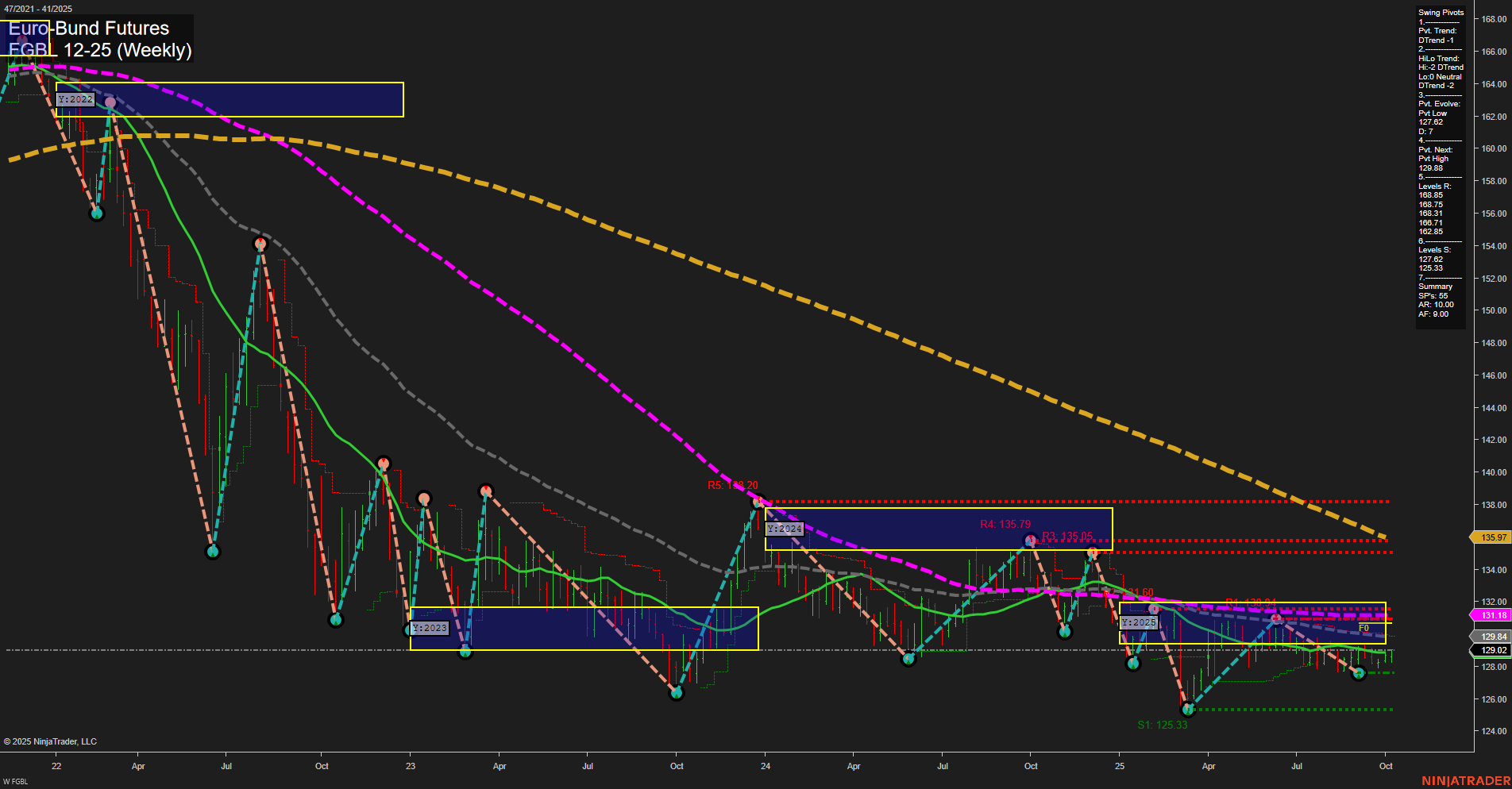
The FGBL Euro-Bund Futures weekly chart shows a market in transition. Price action is subdued, with small bars and slow momentum, indicating a lack of strong conviction in either direction. Short- and intermediate-term Fib grid trends (WSFG, MSFG) are both up, with price holding above their respective NTZ/F0% levels, suggesting some underlying support for a potential bounce or stabilization. However, the long-term yearly grid (YSFG) remains in a downtrend, with price below the NTZ/F0% and negative grid reading, reflecting persistent bearish pressure. Swing pivot analysis highlights a prevailing short-term and intermediate-term downtrend, with the most recent pivot low at 127.02 and the next significant resistance at 139.88. Multiple resistance levels cluster above current price, while support is relatively close below, indicating a market boxed in a consolidation range after a prolonged decline. All benchmark moving averages (from 5-week to 200-week) are trending down and positioned above current price, reinforcing the dominant long-term bearish structure. Recent trade signals have triggered new long entries, reflecting attempts to capture a countertrend move or a mean reversion bounce from oversold conditions. Overall, the market is in a corrective phase within a broader downtrend, with short- and intermediate-term trends showing tentative signs of stabilization but lacking strong momentum. The technical landscape suggests a choppy environment, with potential for range-bound action or minor rallies, but significant overhead resistance and long-term bearish bias remain dominant.